Introduction
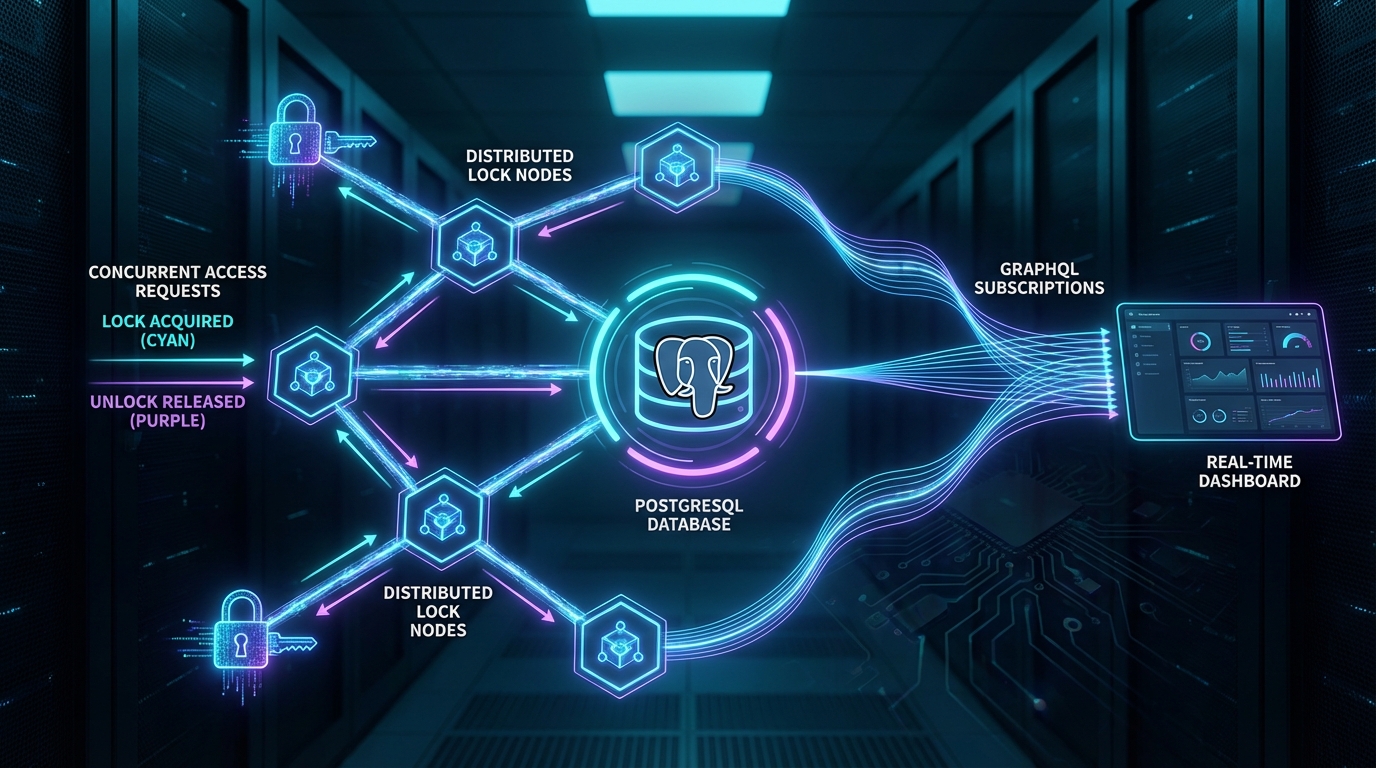
In collaborative SaaS applications, preventing data conflicts is a major challenge. When multiple users or background processes attempt to modify the same record simultaneously, race conditions can lead to data loss or corruption. I recently designed and implemented an Elastic Table Locking System to solve this problem elegantly at the database layer.
The Problem: Concurrency in Collaborative Apps
I needed a system that could:
- Prevent Overwrites: Stop User A from saving changes if User B is currently editing the same record.
- Handle System Locks: Allow background jobs (like webhooks) to lock records during processing.
- Provide Real-time Feedback: Instantly notify the UI when a record is locked or unlocked.
- Enforce Security: Ensure users can only lock records within their own organization.
The Architecture
I chose a “Database-First” approach, leveraging the power of PostgreSQL to handle the heavy lifting of state management and notification.
graph TB
    subgraph "Client Layer"
        UI[Web UI]
        Subscription[GraphQL Subscription]
    end

    subgraph "API Layer"
        GQL[GraphQL Server]
        Mutations[Lock Mutations]
        Queries[Lock Queries]
    end

    subgraph "Database Layer"
        Locks[(Locks Table)]
        RLS[Row Level Security]
        Triggers[DB Triggers]
        Notify[LISTEN/NOTIFY]
    end

    subgraph "Background Services"
        Cleanup[Cleanup Worker]
    end

    UI -->|acquireLock| Mutations
    UI -->|releaseLock| Mutations
    UI -->|lockStatus| Queries
    UI -->|Subscribe| Subscription

    Mutations --> Locks
    Queries --> Locks
    Locks -->|Enforce Multi-tenancy| RLS
    Locks -->|Auto-expire Check| Triggers
    Triggers -->|Emit Events| Notify
    Notify -->|Real-time Updates| Subscription
    Subscription --> UI

    Cleanup -->|Remove Stale Locks| Locks
1. The Database Layer (PostgreSQL)
The core is a dedicated locks table with strict constraints. I used Row Level Security (RLS) to enforce multi-tenancy at the lowest level, ensuring that a user from Organization X can never touch a lock belonging to Organization Y.
Key features implemented in SQL:
- Automatic Expiration: Locks have a
expires_attimestamp. A background cleanup process removes stale locks, preventing “zombie” locks from blocking access indefinitely. - Smart Constraints: Unique constraints ensure only one active lock exists per record entity.
2. The API Layer (GraphQL)
I expose the locking logic via a GraphQL API. This provides a strongly-typed interface for the frontend.
- Mutations:
acquireLock,releaseLock, andextendLockoperations. - Queries:
lockStatusto check if a record is editable. - Subscriptions: This is the “magic” part. Using PostgreSQL’s
LISTEN/NOTIFYchannels, the GraphQL server pushes real-time updates to the client.
subscription OnLockChange($recordId: ID!) {
  lockChanged(recordId: $recordId) {
    status
    lockedBy {
      username
    }
    expiresAt
  }
}
Solving the “Zombie Lock” Problem
One common issue with locking systems is that if a user’s browser crashes or they lose internet connection, the lock might remain, blocking everyone else.
To solve this, I implemented a Heartbeat Mechanism:
- The frontend acquires a lock with a short TTL (e.g., 30 seconds).
- While the user is active, the frontend periodically calls
extendLockto reset the timer. - If the user disconnects, the heartbeat stops, and the lock automatically expires after 30 seconds.
Conclusion
By pushing the concurrency logic down to the database and leveraging GraphQL subscriptions for real-time state syncing, I built a system that is both robust and highly responsive. It eliminates data conflicts and provides a seamless collaborative experience for users.
Tags
