Google has announced Gemini 4 Argon, its newest AI model. It starts at an introductory price of $2 per million input tokens and $10 per million output tokens, then rises to $4 and $20. In Google’s own tests it leads on most tasks below and trails on a few. As of October 2, 2026, access is restricted.
What does it cost?
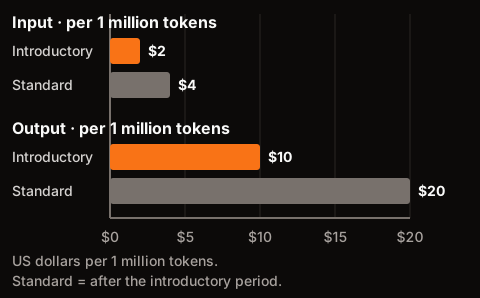
Prices are in US dollars per million tokens. Input is what you send, output is the answer you get back, and cached input is reused material priced at 95% off the input price.
Narrow screen? Scroll the chart sideways to see all of it.
| Token type | Introductory | Standard (after the introductory period) |
|---|---|---|
| Input | $2 | $4 |
| Output | $10 | $20 |
| Cached input | $0.10 | — |
Source: Google's announcement. The introductory cached price is calculated as $2 minus 95%. The standard cached price is not shown in the excerpts used here, so it is left blank.
| Example job | Introductory | Standard |
|---|---|---|
| 1 million in + 1 million out | $12 | $24 |
| 100,000 in + 20,000 out | $0.40 | $0.80 |
These are per-token prices, not a subscription price.
How do Google’s tests compare?
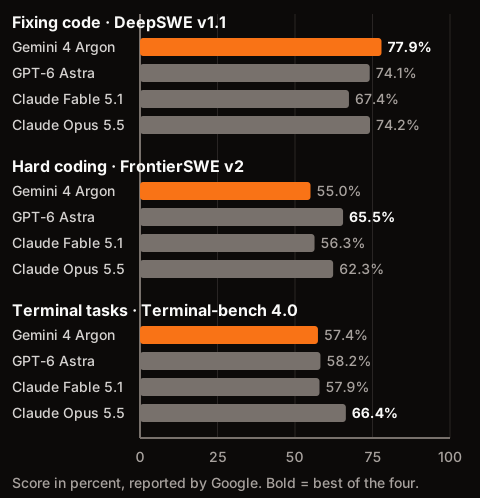
Google compared Argon with GPT-6 Astra, Claude Fable 5.1 and Claude Opus 5.5. These are Google’s own reported results, not an independent test. Compare models within a row, not across rows.
Narrow screen? Scroll the chart sideways to see all of it.
| What it measures | Gemini 4 Argon | GPT-6 Astra | Claude Fable 5.1 | Claude Opus 5.5 |
|---|---|---|---|---|
| Knowledge work · Vals Index | 68.9% | 63.1% | 65.8% | 67.0% |
| Workflow automation · AutomationBench | 51.3% | 41.4% | 31.4% | 42.5% |
| Fixing code · DeepSWE v1.1 | 77.9% | 74.1% | 67.4% | 74.2% |
| Hard coding · FrontierSWE v2 | 55.0% | 65.5% | 56.3% | 62.3% |
| Terminal tasks · Terminal-bench 4.0 | 57.4% | 58.2% | 57.9% | 66.4% |
| Large-document reasoning · GraphWalks 256k to 1M | 84.2% | 71.8% | 65.0% | 66.8% |
Source: Google-reported results. Bold marks the highest score in each row.
Argon is first on four of six rows, with a wide lead on very large documents (84.2% against 71.8%). It is not the best at everything. GPT-6 Astra leads FrontierSWE v2, and Claude Opus 5.5 leads Terminal-bench 4.0.
Independent comparison from Artificial Analysis
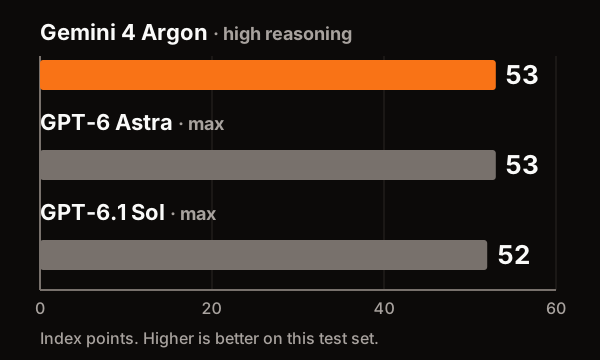
Artificial Analysis, an outside evaluator, combines many tests into one Intelligence Index. It is an index score, not a percent. Its setup differs from Google’s, so do not mix the two.
Narrow screen? Scroll the chart sideways to see all of it.
| Model | Setting | Score |
|---|---|---|
| Gemini 4 Argon | high reasoning | 53 |
| GPT-6 Astra | max | 53 |
| GPT-6.1 Sol | max | 52 |
Argon and Astra tied. Sol was one point behind. That small one-point gap does not tell you which model will work best for you.
Argon also seems to guess less: on a factual test it made up answers far less often than GPT-6 Astra, but it got fewer answers correct overall. Guessing less is not knowing more.
When can you use it?
Google is starting with a small group of trusted testers, rather than opening access to everyone. Ars Technica reported a restricted, phased rollout, and Artificial Analysis described selected users. There is no confirmed broad release date.
A published price is not the same as access. Whether your account can use Argon, or qualify for the introductory price, depends on the rollout. The excerpts used here do not say when the introductory period ends.
Rumored release dates are unconfirmed and are not promises of public access. Wait for Google to confirm when and how you can use it.
What this means for you
- Writing and research: top knowledge-work score, but still check the answers.
- Coding: mixed. It leads one of three coding tests.
- Automation: it leads AutomationBench. Try your own tools first.
- Long documents: its biggest reported lead. Test your own files.
- Budget: the standard price is double the introductory one.
None of this promises how it will perform on your work.
The real test
What would make it worth switching? In my view: access for your account, a price that works at $4 and $20, and a result on your own tasks that beats what you use now. Until then, strong reported results are a reason to watch, not to switch.
Sources and how this was checked
Research cutoff: October 2, 2026. The Artificial Analysis evaluation was published September 30. This article did not test the model, and all scores are as reported and were not reproduced.
Official prices and Google’s benchmark results are transcribed from excerpts of Google’s announcement and results table. The announcement page could not be reached while this article was updated, so it was not re-read. The cached price is calculated from the 95% discount, and the excerpts show no standard cached price or end date for the introductory period.
Google’s results and the Artificial Analysis Intelligence Index use different setups and are never combined here. “High” and “max” are each vendor’s reasoning settings, not the same compute budget, so treat that comparison as approximate. Argon was tested at the highest setting available to it.
Tags
